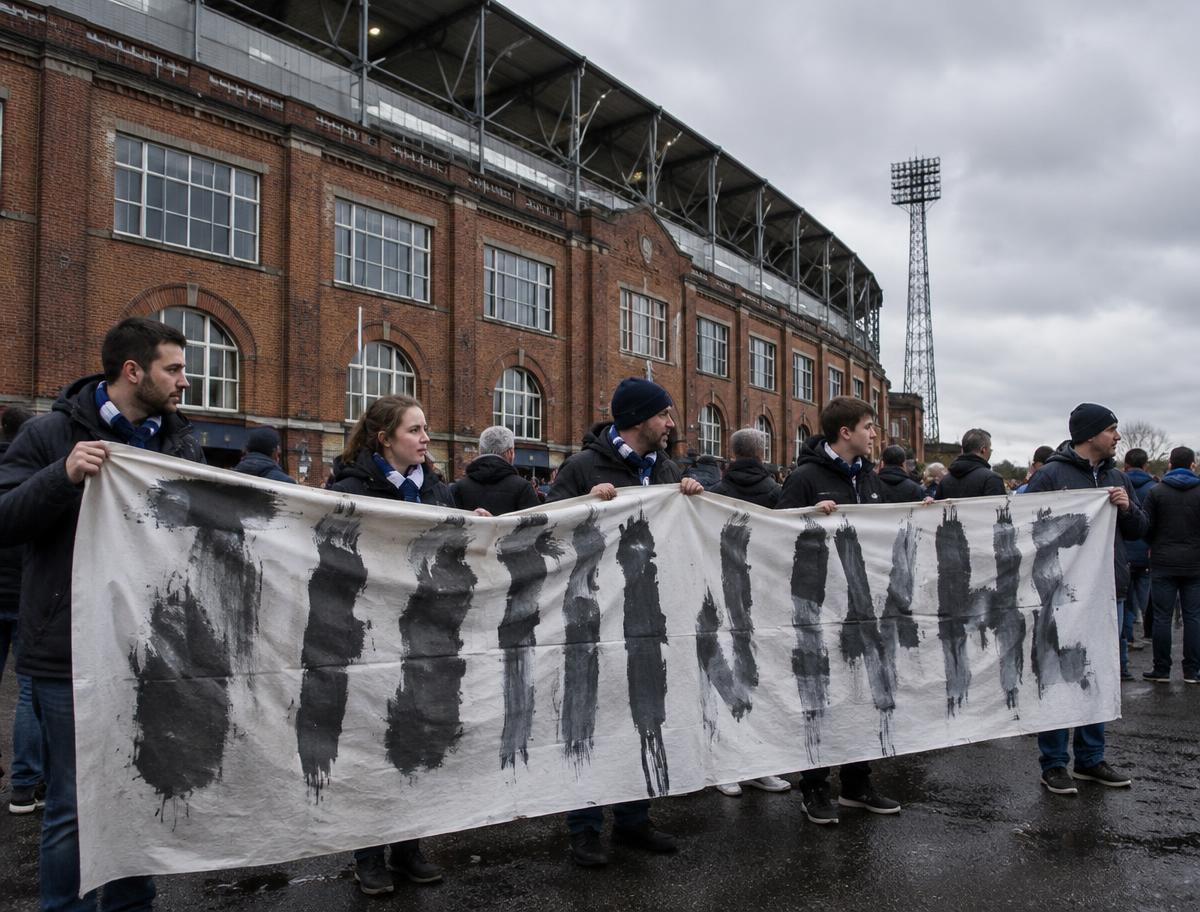
Living on borrowed time and pasty money: the state of lower-league football
The regulator's first State of the Game report says English football is rich, brilliant and one walked-away owner from disaster. Welcome to the part of the pyramid where the floodlights run on a wing and a prayer.
By D. McGrain
5 min readOpinion — the author's argument, not news reporting
If you have ever stood on a League Two terrace on a Tuesday night, where the wind blows sideways and the tea tastes faintly of damp plasterboard, you already know that lower-league football runs on romance. It also, as it turns out, runs on very little else.
This is a follow-up to our piece on [who really owns your club](/stories/who-really-owns-your-club). That one asked who holds the keys. This one asks what happens when the person holding them stops paying the bills.
The State of the Game: a cold bucket of reality
On 13 October the Independent Football Regulator published its draft State of the Game report, and concluded that English football’s finances are “dangerously exposed”. The same report notes the game brings in around £9bn a year. Rich, and on the edge of a financial disaster, at the same time. Impressive multitasking.
The numbers that should make every supporter reach for something stronger than tea:
- 94% of clubs in the top five divisions were loss-making in 2025/26, according to the regulator.
- More than 60% of EFL and National League clubs are “technically insolvent”, which the regulator defines as liabilities exceeding the book value of their assets.
- 29% of clubs told the regulator they could not survive more than 30 days without new owner funding.
- 17 EFL and National League clubs have non-player costs that exceed their total revenue, so they would lose money even if they paid their players nothing.
- The report forecasts total debt in English football rising above £5bn by the end of this season.
Sit with that fourth one for a moment. You could field a team of local builders on a steak bake and a pint each, and those clubs would still be in the red. The wages are not the problem. Everything else is the problem.
A report that tells a club it is broke at every level of ambition is a rare thing. Football has managed it.
When the sugar daddy gets bored
For years the business model has been simple: find someone with money and a soft spot for the badge, and hope they never wake up on a Monday and do the maths.
The regulator’s evidence is that this is exactly what many clubs depend on. It says clubs are “over-reliant on owner funding”, and the majority lack a basic contingency plan if that funding is withdrawn. A town’s 140-year-old institution, resting on one person’s continued good mood.
We know how it can end. Bury were expelled from the EFL in 2019 amid financial difficulties, the first club to drop out of the league since Maidstone in 1992. That is not a cautionary tale from history. It is a preview, for any club whose owner loses interest.
A community asset should not have a single point of failure and a bank balance that belongs to somebody else. If the club is the heartbeat of the town, somebody might want to check who is holding the defibrillator.
The Grand Canyon with a turnstile
The gap between the top and the rest is not a gap any more. The report found that the average Premier League club now earns more than eight times the average Championship side, and that the parachute payment system “contributes to the incentives” for Championship clubs to overspend.
Meanwhile, according to the regulator’s figures, the average Championship club lost £22m in 2025/26, up from £11m in 2021/22. That is what chasing the Premier League looks like: a lottery ticket you pay for in advance with other people’s money, and sometimes the supporters’ own.
Then the pressure rolls downhill. If the club above you is spending like a sailor on shore leave, you feel obliged to offer a four-year deal to a 31-year-old centre-half whose last sprint was in 2019. Everybody is in an arms race, and the stadium heating bill still arrives on the first of the month.
Ask the question the sport keeps dodging: who exactly is this spending for? Not the supporters, who would rather have a club in ten years than a play-off push this May.
Can a regulator save football from itself?
The regulator has now set out a six-point plan and says it will consult on the draft before a final version. Its chair, David Kogan, told BBC Sport: “Seventeen clubs are now trading in such a way that if their players played for free, their non-playing costs would mean they would go bust.”
Behind the scenes, the Premier League and the EFL are still arguing over how much of the top flight’s money reaches the rest of the pyramid. The regulator has powers to step in if they cannot agree. Football has always been brilliant at spending money and strangely reluctant to share it.
When a Premier League club loses money, it is a line in a spreadsheet. When a League Two club loses a few hundred thousand pounds, a town can lose the thing it was known for. Same word, “loss”. Rather different consequences.
The verdict: keep the pies, fix the finances
Lower-league football is a daft, glorious, wet and windy miracle. Where else do you stand on a crumbling terrace, shout at a referee who clearly needs his eyes testing, and know your twenty quid is helping to keep the floodlights on?
But the romance is running on fumes. Real reform means fair distribution of the money, honest financial reporting, and owners who are tested before they are trusted with a town’s identity. It also means asking the supporters, who keep turning up, what they would like.
Now, if you will excuse us, we have to set up a fundraiser for a new lawnmower for the nearest League Two ground.
So, over to you: should Premier League clubs be required to do more for the clubs below them, or should lower-league clubs simply learn to live within their means? Tell us where you stand, and read the [ownership piece and vote in our polls](/stories/who-really-owns-your-club) while you are at it.
This is opinion. The statistics are the Independent Football Regulator’s, from its draft report published on 13 October 2026, and may change before the final version. The jokes, and the verdict, are ours.
Sources & references
- State of the Game report concludes English football dangerously exposed — Independent Football Regulator, 13 October 2026
- State of the Game 2026 — Independent Football Regulator, 13 October 2026
- Majority of clubs on edge of 'financial disaster' - regulator — BBC Sport, 13 October 2026
- Regulator: English football must address finances 'before it is too late' — ESPN / PA, 13 October 2026
- Football regulator to recommend cost controls in landmark report with 94% of clubs making loss — The Guardian, 12 October 2026
Spotted an error? Tell our editors — corrections are noted at the foot of the article.